
Founded MMXXVI
An economics institute.
The Peace Economy Institute applies externality theory to harms that markets leave unpriced. Its flagship is the Peace Dividend Mandate. The method is wider than the first subject.

The Institute publishes working papers, policy briefs, and, in time, books. It engages government, academia, and international institutions. It has concluded, on the merits, that durable peace is the optimal long-run equilibrium, and that the conclusion belongs to everyone.
The organizing conviction is that peace is the presence of an arrangement in which human flourishing is more rewarding, financially and institutionally, than conflict. Poverty, hunger, structural inequality, and preventable disease are not a separate agenda from armed conflict. They are further places where those with the power to avoid a cost have arranged for someone else to bear it. The war economy is the first domain of the method. Companion papers on the carceral economy and the campaign economy are in development.
Four domains
Economics
The theoretical account of armed conflict as an unpriced externality, and the design of market mechanisms that correct it.
Policy
The institutional architecture: the Mandate, the certification authority, the conflict index, and the procurement rules that would make the obligation real.
History and international relations
The documented record of conflicts driven by ideology, territory, and religious mandate, read as tests of the framework rather than as exceptions that retire it.
Moral philosophy
The claim that a world organized around human flourishing is more productive, as well as more just, than the one the war economy keeps in place.
The founder
Christopher Louis is the founder of the Peace Economy Institute. A veteran of the United States Marine Corps and the United States Navy, he retired from the Navy in 2015. He holds a Certificate in Biblical Studies and is an MBA candidate at Southern New Hampshire University. He writes on the economics of war and peace, institutional design, moral philosophy, and religion, and is the author of Love Is the Highest Power: The Fall of Awe, the Rule of Fear, and the Return of Love, a work of interfaith reflection.
His policy work addresses the structural conditions of armed conflict, the financial architecture of the war economy, and the institutional design of durable peace. The Peace Economy Institute advances the argument that peace is the most profitable condition human civilization can produce, and builds the economic, legal, and cultural architecture to make that argument operational.
The Institute welcomes collaboration from economists, legal scholars, conflict-resolution practitioners, military professionals, faith leaders, and policymakers.
christopher@peaceeconomyinstitute.org
ORCID 0009-0008-4590-2792
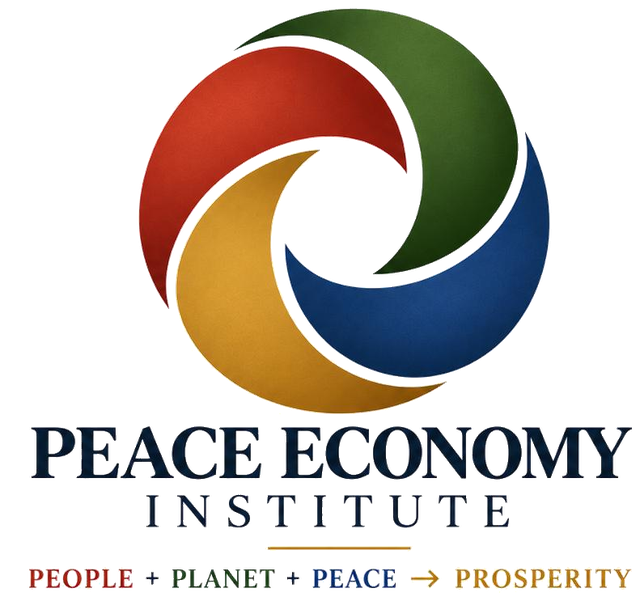
The mark
Four blades, one figure. People in red, the planet in green, peace in blue, prosperity in gold. The line under the name is the method: people, planet, and peace, carried through to prosperity.
The mark belongs to the Institute. The Peace Dividend Mandate is the first paper, not the last subject.
Voice
- Rigorous. Claims rest on the literature and on named sources.
- Egalitarian. The mechanism vests authority in no state and no elite.
- Structural. The Institute names the market failure, not a villain.
- Human. The economics is the method. Flourishing is the object.